Please ensure Javascript is enabled for purposes of website accessibility

Category: Hip Pain

  • Need some stretches for hip osteoarthritis symptoms? Here are 4 that PT experts recommend

    Need some stretches for hip osteoarthritis symptoms? Here are 4 that PT experts recommend

    Hip osteoarthritis (or degenerative joint disease) is a chronic condition that causes the articular cartilage to break down. When left untreated, it can cause pain and loss of mobility in the hip joint.

    Treatment for this condition can include medication, staying active and physical therapy. Stretching exercises are a great way to help keep muscles around your hip strong and flexible. That’s why they’re often used in hip osteoarthritis physical therapy plans. If you have hip osteoarthritis, it’s important to stretch the muscles surrounding your affected joint regularly.

    There are many different types of exercises and stretches for hip osteoarthritis that you can do to keep your muscles strong and flexible. However, it’s important to talk with a medical professional, like a physical therapist, before starting any new exercises so you don’t hurt yourself.

    4 stretches for hip osteoarthritis that may help relieve some of your hip pain:

    1. Standing hip flexor stretch — Stand upright and step back with your affected leg, placing the foot flat on the floor. Next, rotate your hips forward and in the direction of the painful hip. Then, bend your knees slightly and keep pushing your hips forward slowly until you feel a stretch at the front of your hip. Hold the stretch for 15 to 30 seconds. Switch legs and stretch your other hip; then repeat the stretch until you complete three reps on each side. 
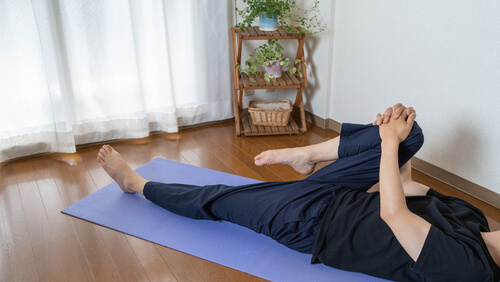
    1. Knee to chest stretch — Lie on your back with your legs extended straight out on the floor and arms at your sides. Pull one knee toward your chest by grabbing the thigh or shin with both hands. Hold for 10 seconds; then relax and repeat on the other side. Perform the stretch four times per leg. Repeat this stretch two to three times per day.
    1. Standing hip stretch — This is an easy stretch that you can do while standing in a doorway. Simply move your non-affected leg out to the side; then lean into the doorway until you feel a gentle stretch in your hip. Hold for 10 seconds and repeat on the other leg.
    1. Figure four stretch — This stretch is also quite simple and can be done while standing or sitting down. You will want to cross one leg over the other and gently pull it toward your torso until you feel a stretch in your buttock and hip. Hold for 10 seconds and then release. Repeat as needed.

    Need more than hip osteoarthritis stretches? Rehab Access PT can help

    Our Rehab Access Physical Therapy team can show you how to do many helpful stretches for hip osteoarthritis. But that’s not all they can do for your hip pain. They can do a free screening on you to uncover other ways to ease your symptoms. They can also build you a unique physical therapy plan intended to help you better manage your pain and help prevent it from interfering with your daily activities. 

    Contact our team today to learn more about our hip osteoarthritis treatments or to set up a free screening.

  • Why would my physical therapist have me do the kneeling hip flexor stretch?

    Why would my physical therapist have me do the kneeling hip flexor stretch?

    It is not always a bad thing to question the treatments that medical professionals prescribe for you. Doing so shows that you are engaged in your treatment. Also, asking questions is an excellent way to learn more about the methods being used to treat you. Asking yourself, “Why is my physical therapist having me do the kneeling hip flexor stretch?”? Read on to find out some possible answers that physical therapists often give for this question. 

    Three reasons your physical therapist is having you do the kneeling hip flexor stretch:

    1. You have a hip flexor injury — The most likely answer to your question is that you have a hip flexor injury, such as a strain. Your hip flexors are a group of muscles that are found at the front of your hips. Their job is to help move your thigh and knee closer to your body. These muscles can be injured anytime you change direction suddenly or if your hip flexors are weak or tight. Physical therapists often prescribe the kneeling hip flexor stretch to help keep the injured hip flexor supple and help keep it free of scar tissue. 
    1. You sit a lot — Medical studies show that Americans are sitting down for a significant portion of their day. One study found that nearly 26% of adults sit for more than eight hours per day. Sitting for prolonged periods can lead to many issues, including tight hip flexors. If you sit for long periods, your physical therapists may ask you to try the kneeling hip flexor stretch to improve your flexibility. 
    1. You have certain types of pain — Tight hip flexor muscles can be a root or contributing cause to many types of pain. Some of these include: 

    Doing certain therapeutic stretching exercises can help ease these types of pain. 

    How can I perform the kneeling hip flexor stretch? 

    Your physical therapist can show you how to perform this stretch properly. The procedure for this stretch often involves: 

    • Kneeling down on your right knee with your left leg bent so that your foot is flat on the floor. 
    • Engaging your core muscles to help keep your torso upright. 
    • Slowly leaning forward until you feel a stretch where your right hip and thigh join. 
    • Holding this stretch for 20 to 30 seconds. 
    • Switching legs to stretch your other side. 

    Find help for your pain that goes beyond stretches at SOL PT

    Stretches like the kneeling hip flexor stretch are hardly the only way to treat hip flexor-related pain. At SOL Physical Therapy, our physical therapists can bring many treatment techniques to bear on your pain. The personalized therapy plan we build for you may include: 

    Contact our team today for more information about how we can help with your pain or to schedule your initial appointment with us. 

  • How Active Release Techniques® works to release tight hips

    How Active Release Techniques® works to release tight hips

    You might be feeling pain in your lower back or knee, but did you know that your pain may actually be rooted in tight hips? 

    The flexibility and mobility of your hip joints is important to how you walk, run and do other normal daily tasks. Tight hips can lead to changes in how you walk and move, which can lead to pain in areas like your knees and lower back. Figuring out how to release tight hips is something that a physical therapist can help you with. Your physical therapist may be able to help you release your tight hips by using Active Release Techniques (ART). 

    What is Active Release Techniques?

    Active Release Techniques combines several types of physical therapy into one helpful treatment option. The “Release” part of this technique involves a physical therapist using their hands to apply pressure to the affected area. The movements your physical therapist’s hands make are similar to a massage. The goal of this pressure is to release tension that has built up in your soft tissue and formed knots, or adhesions. 

    The “Active” part of ART is where you get involved directly. It means that your physical therapist will have you perform a specific movement or series of movements to stretch the affected area. On their own, these movements are known as therapeutic exercises. 

    How Active Release Techniques works to release tight hips

    There are several steps your physical therapist is likely to take when using ART to release your tight hips. These steps can include: 

    1. Examination — Your physical therapist will usually perform a physical examination of the affected hip before beginning ART. This exam allows them to get a better sense of how restricted your hip is. 
    1. Shortening the affected tissue — You will then be shown how to shorten the tissue that needs to be released. 
    1. Stretching the affected tissue — Your physical therapist then has you do a specific stretch to elongate the affected tissue. Don’t worry. They’ll show you exactly how they want you to stretch the area. 
    1. Applying pressure — As you stretch the area, your physical therapist applies pressure to the affected area using massage-like movements.

    Find out more about how to release tight hips at SOL PT

    Are you struggling to figure out how to release your tight hips? Our SOL Physical Therapy team is primed to help you with this common problem. We can perform a thorough physical examination of your hips to pinpoint the tight areas. Then, our physical therapists can build you a personalized treatment plan that may include ART and other effective physical therapy methods. 

    Contact our team today for more information about how we can assist with your hip problems or to schedule an initial appointment. 

  • Three stretches physical therapists use for hip arthritis

    Arthritis can make your hips feel tight and difficult to move, and this can make you feel like you don’t want to move around as much. In turn, not moving around enough can actually increase your hip arthritis pain. 

    There are many people who experience this chain of circumstances. In fact, medical studies report that 18.5% of men and 28.6% of women develop hip osteoarthritis in their lifetime. Fortunately, physical therapists can help you find effective stretches and other treatment techniques for hip arthritis. Some stretches that your physical therapist may recommend to ease your hip arthritis symptoms include the: 

    1.  Inner leg stretch
    Purpose: The inner leg muscles are also called the hip adductors, and stretching these muscles can help reduce hip arthritis pain. 

    How to do the inner leg stretch:

    • Sit down on the floor. 
    • Bend your knees so that the soles of your feet are touching. 
    • Keep your feet on the floor, and place your hands on top of your knees.
    • Apply light downward pressure on your knees until you feel a stretch in your inner thighs. 
    • Hold this stretch for 10 to 15 seconds. 
    • Release the pressure on your knees and rest for a few seconds. 
    • Repeat the stretch until you’ve done it five to 10 times. 

    2.  Knees-to-chest stretch

    Purpose: Tightness in the glutes and lower back muscles can lead to greater hip arthritis pain. The knees-to-chest stretch can help reduce the tightness in these muscles and decrease your pain.

    How to do the knees-to-chest stretch:

    • Lie down on your back with your legs straight out. 
    • Slowly lift both knees up toward your chest. 
    • Place your hands on your legs just below your knees.
    • Gently pull your knees toward your chest until you feel a stretch in your butt and lower back. 
    • Hold this stretch for 20 to 30 seconds. 
    • Repeat this stretch as necessary throughout the day.

    3.  Double hip rotation stretch

    Purpose: This stretch is designed to reduce tension in the hip abductors, glutes and lower back, which can help reduce hip arthritis discomfort. 

    How to do the double hip rotation stretch:

    • Lie down flat on your back with your legs straight. 
    • Bend your knees until both of your feet are flat on the floor. 
    • Slowly rotate your knees to the right while rotating your head to the left at the same time. Your goal should be to touch your right knee to the floor. Be sure to keep your knees together throughout the movement. 
    • Hold this position for 20 to 30 seconds. 
    • Return your knees and head to the neutral position. 
    • Slowly rotate your knees to the left and your head to the right to stretch your other side. 
    • Hold this position for 20 to 30 seconds. 

    Want to find more stretches and physical therapy methods for hip arthritis? Armor PT can help

    Stretches aren’t the only useful technique that physical therapists can use for hip arthritis. Our team at Armor Physical Therapy can show you all the other treatment options we offer for your arthritis. We can start by doing a free screening of your affected hip. This is intended to help us learn how your arthritis is affecting you. 

    In addition, our physical therapists excel at building personalized therapy plans designed to reduce your arthritis pain and improve your joint mobility. We can even help you treat your symptoms from home using our virtual therapy or at-home care services. 

    Contact us today for more information about how we can help treat your hip arthritis or to schedule your initial appointment.

  • Three sports injuries that can lead to both lower back and hip pain

    Three sports injuries that can lead to both lower back and hip pain

    Dealing with minor aches and pains is something that many athletes take for granted. However, some athletes may develop moderate to severe lower back and hip pain, and these forms of pain are often caused by specific sports injuries. 

    It’s not uncommon for U.S. athletes to experience an aching lower back or hip. One medical study reports that up to 94% of athletes feel some level of lower back discomfort annually. Another study reveals that about 10% of people who seek help from sports medicine professionals have hip or groin pain. Meeting with a physical therapist can help you learn what is causing your lower back and hip pain, and you can also get effective treatment for your pain from these medical professionals. 

    Lower back and hip pain can come from these three sports injuries: 

    1. Ligament, muscle or tendon injuries — Ligaments are soft tissue structures that connect a bone to another bone. Tendons connect muscles to bones, and muscles allow your body to move. All these structures must work together when you’re playing a sport. However, they can also be sprained, strained or torn. If the injured structure is located in either the hip or lower back, you may feel discomfort in both areas. 
    1. Herniated lumbar disc — Many sports require some level of lower back movement. Yet repetitive movements, sudden stress or impacts can all injure a disc in your lumbar spine. A herniated disc occurs when the outer covering of a spinal disc is damaged. The disc’s inner material is then able to poke out or herniate, which can trigger local and radiating pain. 
    1. Sciatica — Your sciatic nerve runs from your lower back, through your buttocks near the hips and down the back of your legs. A lower back or hip impact can easily cause a section of this nerve to be pinched. In turn, sciatica can trigger burning or shocklike pains along the entire length of the nerve. 

    What can physical therapists do to treat lower back and hip pain caused by sports injuries?

    Physical therapists can help you treat many musculoskeletal disorders caused by playing sports. These specialists can take treatment steps such as: 

    • Identifying the root cause of your pain.
    • Educating you about the injury you have. 
    • Employing aquatic therapy to relax and strengthen the injured area of your body. 
    • Developing a therapeutic exercise program for you that can help speed up your recovery. 
    • Helping you avoid future sports injuries. 

    Rehab Access offers treatment for sports injuries that cause lower back and hip pain

    Do you have a sports injury that’s left your lower back and hip painful? Our team at Rehab Access Physical Therapy is ready and willing to help you address your injury. We can do a free screening to determine what type of injury is causing your pain. Next, our physical therapists will construct an individualized therapy plan for you that’s designed to: 

    • Reduce your pain.
    • Supercharge your recovery process. 
    • Improve your flexibility and strength. 
    • Get you back to playing as fast as possible. 
    • Help you avoid future sports injuries. 

    Contact our team today for more information about our sports injury treatment services or to schedule an initial appointment to begin treating your injury.

  • What exercises can I do for my lower back and hip pain?

    What exercises can I do for my lower back and hip pain?

    The lower back, or lumbar region, and hips are closely linked by muscles and nerves, and often, a problem in one of these areas will lead to pain in both of them. 

    There are many issues that can trigger both lower back and hip pain. Osteoarthritis can affect structures in both areas and lead to progressively increasing pain. A herniated lumbar disc can pinch a nerve and trigger pain in the lumbar region and hip. Physical therapists can help you address these and other issues that can lead to lower back and hip pain. One technique that’s often used for addressing pain in these areas is therapeutic exercises, and some of the exercises that your physical therapist might recommend you do include the following: 

    1. Figure 4 stretch

    Purpose: This stretch is intended to stretch the glutes, which can help reduce your lumbar and hip pain. 

    How to do the figure 4 stretch:

    • Lie down on your back so that you’re facing up toward the ceiling. Place a yoga mat under you if you need some additional padding. 
    • Bend both of your knees and place both feet flat on the floor. 
    • Cross the ankle of your painful hip over your other thigh. 
    • Wrap your hands around the back of your non-painful thigh just above the knee.
    • Slowly pull your non-painful leg toward your chest until you feel a stretch in your other buttock. 
    • Hold this stretch for 15 to 20 seconds. 
    • Repeat this stretch at least three times. 
    1. Knees-to-chest stretch

    Purpose: This exercise can help stretch your buttock and lower back muscles and help decrease lower back and hip pain. 

    How to do the knees-to-chest stretch: 

    • Lie down on your back on a yoga mat or mattress. 
    • Bring both knees up toward your chest. 
    • Place one hand on the back of each thigh just above your knee. 
    • Use your hands to gently pull your knees even closer to your chest until you feel a stretch in your butt and lower back. 
    • Hold this stretch for 20 to 30 seconds. 
    • Release and rest for a few seconds. 
    • Repeat the stretch until you’ve completed it three to five times. 
    1. Lying march exercise

    Purpose: This exercise helps to gently stretch and strengthen your hip, buttock and lower back muscles, which can help prevent future lower back and hip pain.

    How to to the lying march exercise:

    • Lie down on your back on the floor. Use a yoga mat to provide additional padding if necessary. 
    • Place both feet flat on the floor so that your knees are slightly bent. 
    • Slowly lift your right foot a few inches off the floor. 
    • Hold it in this position for two to three seconds. 
    • Slowly lower your foot back to the floor. 
    • Repeat this movement with your left leg. 
    • Alternate from one leg to the other until you’ve done eight to 10 repetitions. 

    Find help treating your lower back and hip pain at SOL PT

    Keen to find more effective treatment options for your lower back and hip pain? Our team at SOL Physical Therapy offers many treatment techniques that can help address your pain. We can start by doing a comprehensive evaluation to determine the cause of your pain. Then, our physical therapists will build you a personalized therapy plan designed to reduce your pain. You can even sign up for virtual therapy sessions that allow you to treat your pain from home. 

    Contact our team today for more information about how we can treat your pain or to schedule your initial appointment. 

  • Can you have both lower back and hip pain?

    It may seem odd, but the answer to this question is clearly found in a children’s song. Anyone who’s ever heard or sung “The Skeleton Dance” knows that “the hip bone’s connected to the backbone.” This is a simplistic interpretation of the connection between the hips and the lower back, but it illustrates that you can experience pain in both areas at once. 

    Physical therapists can help you learn more about what’s causing the pain in these areas. They also have access to potent treatment options that can help reduce your lower back and hip pain. 

    What’s causing your lower back and hip pain? 

    The connection between the hips and lower back (lumbar area) goes beyond bones. These two areas of the body are also connected by cartilage, nerves, muscles and other soft tissue. A problem with any one of these structures can lead to discomfort and other troublesome symptoms. Some of the issues that could be causing your hip and lower back to ache include: 

    • Hip osteoarthritis — A condition that develops as hip joint cartilage wears out over time. 
    • Sciatica — A problem that develops when one of the sciatic nerves becomes irritated or pinched. 
    • Spinal osteoarthritis — This condition develops naturally as people age. It occurs when cartilage, vertebrae and spinal discs begin to wear out. 
    • Pregnancy — Pregnancy releases chemicals that relax the soft tissue in the pelvic area, which can lead to misalignment and aching in the lower back and hips. 
    • Muscle strains — A condition that develops when you overstretch a lower back or hip muscle. 
    • Ligament sprains — This issue is when a hip or lower back ligament is overstretched or slightly torn. 

    How can a physical therapist treat your lower back and hip pain?

    Physical therapists have many techniques they can use to treat lower back and hip discomfort. The most likely treatment avenue for aching in these areas is a personalized treatment plan that may include therapy methods such as: 

    • Therapeutic exercises intended to stretch and strengthen muscles in your hips, lower back and stomach. 
    • Joint mobilization that can help improve the flexibility of the hip and sacroiliac joints. 

    Find help treating your lower back and hip pain at Armor PT

    Looking for help treating lower back and hip pain? Our Armor Physical Therapy team is primed to help you find effective care for your pain. We offer free screenings that are designed to pinpoint the cause of your pain. 

    Our team can then build you an individualized therapy plan intended to reduce your pain and prevent future issues that can cause pain. We can even help you treat your pain from home. This is possible thanks to the at-home care and virtual therapy services we offer. 

    Contact us today for more information about all the treatment options we offer for lumbar and hip pain or to schedule an initial appointment. 

  • What’s causing me hip pain when I’m sleeping on either side?

    What’s causing me hip pain when I’m sleeping on either side?

    Are you experiencing hip pain when sleeping on either side of your body? Working with a physical therapist can help you determine the source of your pain. 

    Hip pain is a common problem for Americans. One medical survey reports that more than 19% of the people who responded had hip pain. The survey also reveals that 52% of the respondents had pain in both hips. These statistics make it clear that dealing with hip pain when sleeping on either side is a much more common problem than many people might believe. Physical therapists can use their extensive knowledge to pinpoint the cause of your pain. Also, they can help you find ways to effectively treat and manage your hip pain. 

    Four issues that can cause hip pain when you’re sleeping on either side

    The human musculoskeletal system is the body system that physical therapists are trained to treat. Your hip joints are just one of the structures in this system. Some of the issues that your therapist may identify as the cause of your hip pain when sleeping on either side include: 

    1. Poor sleeping position — A 2012 sleep survey found that 74% of the respondents slept on their side. Yet this position can lead to pain in both of your hips. Direct pressure on the hip you’re lying on can be enough to trigger pain. Also, the other hip can be pulled out of alignment and start to ache when you’re lying on your side. Some people may find relief from their pain by sleeping with a pillow between their legs. 
    1. Hip osteoarthritis — Cartilage in the hip joints can wear out as we get older and cause some people to develop hip osteoarthritis. The pressure that side sleeping places on an arthritic hip can trigger increased arthritis pain at night. Staying in one position for long periods has also been shown to cause increased arthritis pain. 
    1. Hip bursitis — The trochanteric bursa is a pillowlike structure located at the point of your hip. Trochanteric bursitis occurs when this structure becomes inflamed. It’s estimated that 6.6% of women and 1.9% of men develop this condition in both hips at the same time. As a result, sleeping on either hip may lead to discomfort at night. 
    1. Sacroiliac joint dysfunction — The sacroiliac joints are located at the back of your pelvis. They connect the pelvic girdle to the lower spine. Inflammation in these joints is called sacroiliac joint dysfunction. This issue often causes pain in the pelvis, buttocks, hips and lower back. Sleeping on your side can increase pressure on the inflamed joints and trigger more pain. 

    Find help at Rehab Access for your hip pain when sleeping on either side

    Determined to find effective treatment for the hip pain you feel when sleeping on either side? Our Rehab Access Physical Therapy team is prepared to help you meet this goal. Our specialists can do a free screening on your hips to diagnose the cause of your pain. Then, we can build you a personalized treatment plan designed to decrease your pain. 

    Contact our team today for more information about the treatment options we offer for hip pain or to schedule an initial appointment.

  • Two physical therapy exercises that can help your hips

    Your hip joints are some of the most important structures in your body, and they’re involved in normal daily activities like walking, running and climbing stairs. However, problems with the muscles around your hip can trigger pain and other symptoms. 

    Hip pain is a common issue for Americans. Up to 40% of people who play sports develop hip pain, and up to 15% of U.S. adults over 60 also have hip pain. Working with a physical therapist can help you learn how to avoid many causes of hip pain. These specialists can use many techniques to help prevent hip pain, but physical therapy exercises can be especially useful for people with this goal. A few therapeutic exercises that your therapist could recommend to prevent hip issues include the: 

    1. Supine hamstring stretch

    Purpose: This exercise is often used by physical therapists for hip issue prevention because it can help reduce tension in the hamstring muscles. 

    How to do the supine hamstring stretch: 

    • Lie down on your back on a yoga mat or bed. 
    • Bend your right knee and place your right foot flat on the floor. 
    • Leave your left leg straight with your toes pointing toward the ceiling. 
    • Clasp your hands around the back of your right thigh. 
    • Pull your thigh toward your chest until it forms a 90-degree angle with the ground.
    • Slowly straighten your leg until you feel a stretch in the back of your thigh. 
    • Hold this stretch for 20 to 30 seconds. 
    • Switch legs and repeat the stretch with your left leg. 
    • Continue to stretch your legs until you’ve done both legs three times. 
    1. Hip flexor stretch

    Purpose: The hip flexor stretch is a physical therapy exercise that’s designed to reduce tension in your hip flexors. 

    How to do the hip flexor stretch: 

    • Kneel down on the floor on your left knee and place your right foot flat on the floor in front of you.
    • Maintain good, upright posture in your back and neck.
    • Tighten your abs. 
    • Push your body forward until you feel a gentle stretch in the front of your left hip. 
    • Hold this stretch for 45 to 60 seconds. 
    • Switch legs and stretch your right leg. 
    • Repeat the stretch until you’ve targeted each leg three times. 

    Find even more help with hip issue prevention and treatment at Armor Physical Therapy

    Are you looking for physical therapy to help treat or prevent a hip problem? If you are, look no further than our team of specialists at Armor Physical Therapy. We offer free screenings that can identify any current hip issues you have, and this service can even pinpoint underlying issues that can lead to future hip problems. 

    In addition, our physical therapists are adept at building personalized therapy programs designed to reduce your pain and prevent future hip issues. We can even assist you right in your own home thanks to our at-home care and virtual therapy services. 

    Contact us today for more information about how we can help you treat and prevent hip issues or to schedule an initial appointment. 

  • Three ways physical therapy can help people with a torn hip labrum

    Three ways physical therapy can help people with a torn hip labrum

    The hips are working every single time you walk or get into or out of a chair, and such common daily activities can be much harder when you have a torn hip labrum. However, a physical therapy plan can help you treat this hip injury. 

    The hip labrum is a piece of cartilage that lines the rim of your hip socket. It helps keep the ball of the femur seated in the hip socket, and it also helps keep hip movements smooth. Issues like trauma from playing sports or femoroacetabular impingement (FAI) can lead to a torn hip labrum. Physical therapy is often the first-line treatment for a torn hip labrum, and it can help you in several important ways. 

    Ways physical therapy for a torn hip labrum can help you

    The main goal of physical therapy for a torn hip labrum is to help you get back to your normal daily activities. To meet this goal, physical therapists can work to help: 

    1. Reduce your pain — A hip labral tear typically causes pain in the hip. It can also trigger pain in the groin or buttocks. Reducing your pain is one way physical therapy can help you. Typically, therapy plans will be built using several therapy techniques. One study found that a multitechnique physical therapy plan helped 75% of patients completely relieve their pain in 12 weeks. 
    1. Improve hip muscle strength — Weak hip muscles can lead to the joint misalignment that often causes a hip labral tear. In addition, weakness in hip muscles can leave you open to another hip injury in the future. These are two reasons physical therapy typically seeks to improve your hip muscle strength. A hip labral tear study reports that 12 weeks of physical therapy helped improve patients’:
    • Hip flexor strength by up to 39%.
    • Hip abductor strength by up to 56%.
    • Hip extensor strength by at least 68%.
    1. Prepare for and recover from surgery — Many minor hip labrum tears may not require surgery. However, more serious tears or ones that don’t respond to treatment may need surgery. Physical therapy can still help you if you do need surgery. A type of therapy called pre-surgical rehab (pre-hab) can help prepare your body for surgery. After your surgery, a post-surgical rehab plan can help you recover faster. 

    Find physical therapy for your torn hip labrum at Continuum Wellness

    Want to find top-notch physical therapy for your torn hip labrum? Our Continuum Wellness team is made up of highly experienced physical therapists who can help treat this issue. We’ll start your therapy process with a free screening to confirm you have a hip labral tear. Next, our physical therapists will construct an individualized therapy plan for you. Such a plan can offer all three of the benefits discussed above. 

    Is your hip problem making it difficult to leave home? No worries! You can work with our team via an at-home care or virtual therapy appointment that takes place right in your own home.

    Contact our team today for more information about our therapy services for hip issues or to schedule an initial appointment.

  • Two exercises that can help your hip bursa pain

    Two exercises that can help your hip bursa pain

    Running or walking with poor form. Lifting heavy weights repeatedly with your legs. Weakness in your thigh or glute muscles. These are all factors that can lead to hip bursa pain or hip bursitis. 

    Bursae are small, fluid-filled sacs that reduce friction between muscles and bones. One place where you can find these structures are in your hip, and hip bursitis can result if your hip bursae become inflamed. It’s estimated that 2 in every 1,000 people develop hip bursitis yearly. 

    Physical therapists can help you find therapeutic exercises to reduce your hip bursa pain and strengthen the muscles that support the hips. Here are two exercises your therapist could use to accomplish these goals:

    1. Lying lateral leg raises

    One exercise your therapist may have you perform to reduce hip bursa pain is the lying lateral leg raise exercise. This movement is helpful because it’s intended to help strengthen many muscles that support your hips. Some of the muscles targeted by this exercise include the gluteus medius, gluteus minimus and quadriceps.

    How to do the lying lateral leg raise exercise

    • Lie down on a yoga mat or mattress so that your affected hip is facing the ceiling. 
    • Slowly lift your leg up as far as you can. Keep your toes pointed to the front and your leg as straight as possible. 
    • Hold at the top of the movement for two or three seconds. 
    • Slowly lower your leg back down until it’s resting on your other leg. 
    • Continue to raise and lower your leg until you’ve done 15 to 20 repetitions.
    • Take a short break to rest your leg, and then repeat the exercise until you’ve completed three or four sets of 15 to 20 reps. 
    1. Lying leg circles

    Another exercise physical therapists often use to help people with hip bursa pain is lying leg circles. This exercise can be tweaked to fit people in various stages of recovery, and it can also help improve strength in muscles like the hip flexors, quadriceps and gluteal muscles.

    How to do lying leg circles

    • Lie down flat on your back on the floor or a mattress. 
    • Straighten the affected leg as much as possible and lift it about 3 inches off the floor. 
    • Do five small circles to the left, and then do five small circles to the right. You can increase the difficulty by making the circles bigger. 
    • Lower your leg back down and take a short break. 
    • Repeat these steps until you’ve completed them three or four times. 

    Advent Physical Therapy offers treatment for hip bursa pain

    Besides exercises, there are other ways that physical therapists can help treat your hip bursa pain. Our team at Advent PT is ready and willing to help you learn all about our treatment options for this type of pain. We offer free screenings that can confirm that your hip bursa is the source of your discomfort. Also, our therapists are adept at building unique therapy plans that can include techniques like: 

    Contact our team today for more information about how we can help treat your hip bursitis symptoms or to schedule an initial appointment.

  • Is hip pain during pregnancy common?

    Is hip pain during pregnancy common?

    Many women are aware that lower back pain and pelvic pain are common during pregnancy. However, they might not be aware that it’s also common to experience hip pain during pregnancies. 

    One study found that slightly more than 32% of women experienced hip pain while they were pregnant. There are many reasons why so many pregnant women are at risk of developing aching hips. Physical therapists can help these women learn the factors that increase their risk of hip pain during pregnancy. They can also help you find ways to reduce your hip pain. 

    Common factors that increase the risk of hip pain during pregnancy

    The changes in your body during pregnancy can lead to many types of discomfort, including aching hips. However, knowing what factors increase your risk of hip pain can help you reduce or even prevent yourself from developing it. Some of the most common factors that increase the likelihood of hip discomfort in pregnant women are: 

    1. Weight gain — Your body is supposed to gain weight as your pregnancy progresses. However, this extra weight can put more stress on your hips. This added stress can cause hip muscles, ligaments and tendons to become irritated, inflamed and painful.
    1. Changes in hormone levels — The levels of many hormones change when you’re pregnant. One hormone that can lead to painful issues is relaxin. This hormone helps soften and loosen the soft tissue in your pelvic area before you give birth. A result of these soft tissue changes is that your hips could become misaligned and painful. 
    1. Weakening of core muscles — Your posture tends to change during pregnancy because of the extra weight you’re carrying. These postural changes can tire out your core muscles and add stress onto your hips. The additional stress can then lead to inflammation in the hip joint that causes pain. 

    How can a physical therapist help reduce your hip pain during pregnancy?

    Physical therapists can take the risk factors above into account when creating your treatment plan. They’ll also do a physical examination to see exactly what’s triggering your hip pain. This allows them to create physical therapy plans that are personalized to an individual’s needs. 

    Some of the therapy techniques that can be used in your therapy plan include: 

    Find help for your hip pain during pregnancy at Excel PT

    Are you experiencing hip pain during your pregnancy? If you are, our women’s health team at Excel Sports & Physical Therapy in Creve Coeur, Missouri, is ready and willing to help you treat it. We offer free screenings that can pinpoint the cause(s) of your pain. Also, our specialists are adept at creating customized therapy plans designed to offer benefits like: 

    • Decreased pain.
    • Improved hip mobility.
    • Increased ability to do normal daily tasks.
    • Higher likelihood of preventing future hip pain. 

    Our team also offers virtual therapy and at-home care services designed to help you get therapy right in your own home.

    Contact our team today for more information about the hip pain treatment options we offer or to schedule an initial appointment. 

When Was Your Appointment?

We recently changed bill pay providers. Please click the button for the date of your appointment to be directed to the correct online payment portal.